Leo Strauss and the Problem of Political Philosophy by Michael P. Zuckert & Catherine H. Zuckert
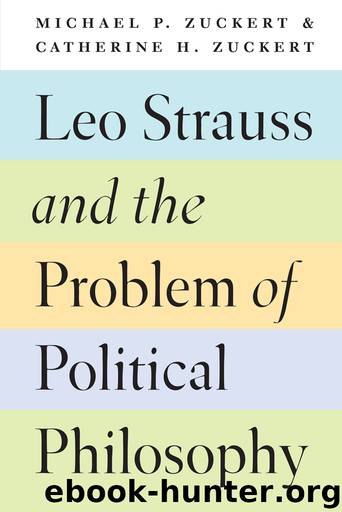
Author:Michael P. Zuckert & Catherine H. Zuckert [Zuckert, Michael P.]
Language: eng
Format: epub
Publisher: University of Chicago Press
Published: 2014-11-08T16:00:00+00:00
Part III
Strauss in the Twentieth Century
CHAPTER NINE
Strauss’s Practical Politics
From Weimar to America
Critics have often decried Strauss’s political attachments to the right. Some now go beyond accusing him of being a conservative critic of liberalism or of ostensibly having inspired the “neoconservative” foreign policies of the George W. Bush administration, and maintain that in the early 1930s Strauss openly sympathized with fascist imperialists, and even Nazis, and that he continued to advocate authoritarian politics, although more covertly, after he emigrated to the United States.1
In The Truth about Leo Strauss we responded to the charge that Strauss was the “mastermind” of the foreign policy of the Bush administration by showing that he did not favor imperialistic policies of either a liberal democratic Wilsonian or a more Machiavellian kind, and that he did not advocate the rule of a “philosophical elite.” In this chapter we respond to Strauss’s more extreme critics.
To show that Strauss was not a student or follower of Carl Schmitt, as some of these critics maintain, in the first part of this chapter we examine the review Strauss wrote of Schmitt’s influential 1932 book The Concept of the Political. We argue that the critics’ charges rest on a serious misreading of that review. And to disprove the claim that Strauss presented a Schmittian understanding of politics covertly in his later work, we contrast the “concept of the political” Strauss drew from his study of classical political philosophy with the Schmittian “concept” he had criticized in his review.
In the next part of this chapter we then examine the second and perhaps more serious source of the critics’ charges, a letter that Strauss wrote to Karl Löwith shortly after Hitler came to power but that was published only in 2001. Rather than a profession of his own fascist political principles, we argue, the letter conveys Strauss’s view of the political facts in Germany in May 1933 and the options open or closed to Jewish intellectuals at that time. Strauss explained his understanding of the political and intellectual circumstances in which he wrote the letter more fully in a talk he gave called “German Nihilism” in 1941.
Asked in the midst of World War II what was the true political doctrine, Strauss responded: “We shall not hesitate to answer: liberal democracy.”2 But he went on to caution Americans against an attempt to impose such a regime on Germany after the war, because he thought the Germans would not accept it. Why did Strauss favor liberal democracy where it could be established? In another talk that he wrote in the 1960s but that was not published until after he died in 1973, Strauss observed that the theoretical crises he had analyzed in modern political philosophy do not necessarily lead to a practical crisis. Although its theoretical foundation in modern political philosophy is defective, “liberal democracy . . . derives powerful support from . . . the premodern thought of our western tradition” (“TWM,” 98). In the third and last part of this chapter we seek
Download
This site does not store any files on its server. We only index and link to content provided by other sites. Please contact the content providers to delete copyright contents if any and email us, we'll remove relevant links or contents immediately.
The Secret History by Donna Tartt(19320)
The Social Justice Warrior Handbook by Lisa De Pasquale(12228)
Thirteen Reasons Why by Jay Asher(9011)
This Is How You Lose Her by Junot Diaz(6965)
Weapons of Math Destruction by Cathy O'Neil(6373)
Zero to One by Peter Thiel(5876)
Beartown by Fredrik Backman(5859)
The Myth of the Strong Leader by Archie Brown(5554)
The Fire Next Time by James Baldwin(5509)
How Democracies Die by Steven Levitsky & Daniel Ziblatt(5280)
Promise Me, Dad by Joe Biden(5193)
Stone's Rules by Roger Stone(5134)
A Higher Loyalty: Truth, Lies, and Leadership by James Comey(5021)
100 Deadly Skills by Clint Emerson(4975)
Rise and Kill First by Ronen Bergman(4842)
Secrecy World by Jake Bernstein(4807)
The David Icke Guide to the Global Conspiracy (and how to end it) by David Icke(4777)
The Doomsday Machine by Daniel Ellsberg(4559)
The Farm by Tom Rob Smith(4557)
